
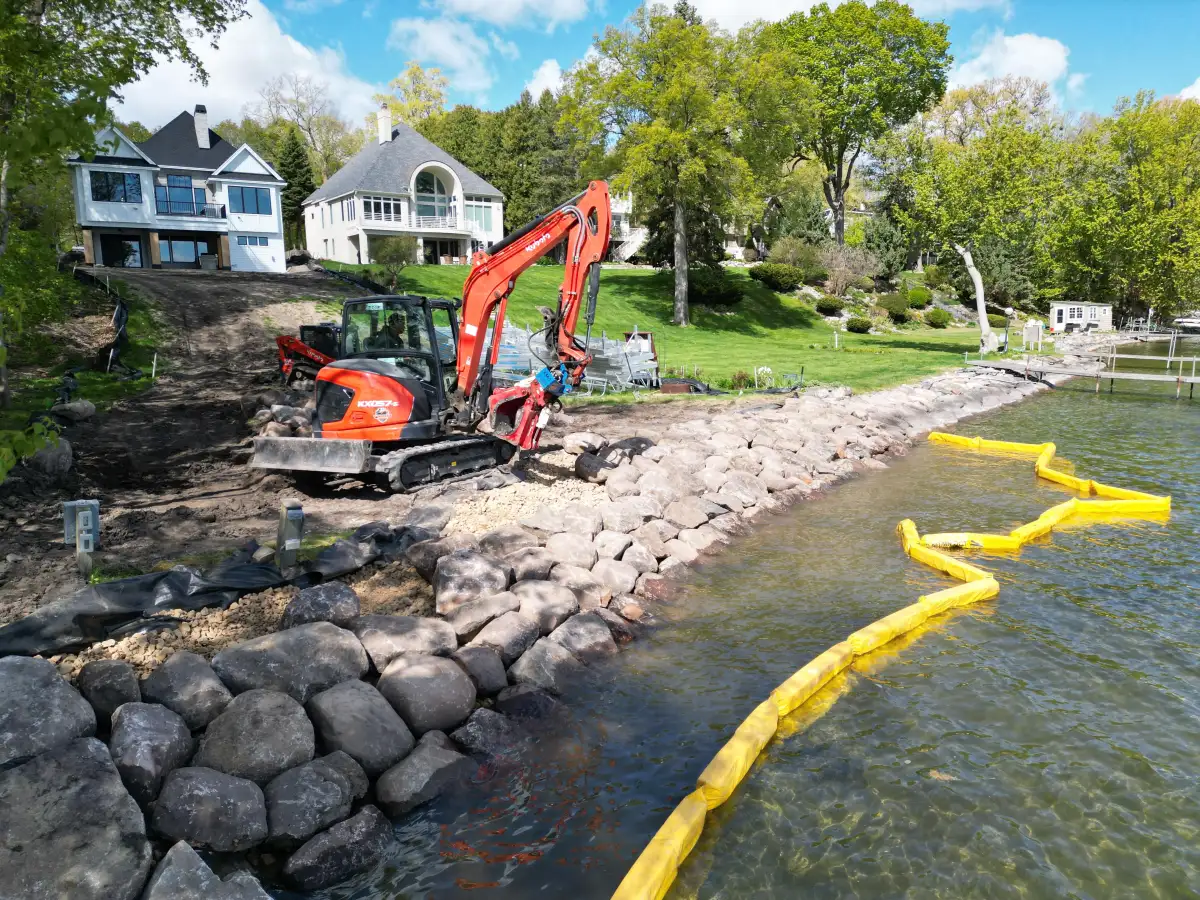
- 01Document the edgePhotograph erosion, exposed roots, ice damage, and upland flow.
- 02Confirm reviewsIdentify city or watershed requirements before setting dates.
- 03Plan accessChoose a route and staging area that protects the property.
- 04Stabilize and restoreCoordinate toe stone, fabric, riprap, grading, and planting.
Short answer: before booking a Shorewood landscape contractor, ask how the estimate handles drainage, grading, access, materials, design, permits, and jobsite communication. The right contractor should understand the whole property rather than price only the visible feature.
That distinction matters around Shorewood and Lake Minnetonka. A new patio can fail if water is pushed toward the house. A retaining wall can create pressure if drainage is left out. A stairway can feel awkward if grade, landing depth, and future planting zones are not reviewed together. A full outdoor living plan can become expensive when lighting, sleeves, access, and restoration are treated as afterthoughts.
Lifecycle Outdoor Services provides landscape construction throughout Shorewood and nearby communities. Share photos and project goals through the estimate form to start a site-specific conversation.
Start with the erosion pattern, not the rock size
Many estimate calls begin with a simple request: "We need a patio," "the wall is leaning," "the yard holds water," or "we want a better backyard." A useful landscape contractor should turn that request into a site-specific scope. That means asking what caused the current condition, how the new work will connect to the house, how water will move, and whether the project should be handled in one phase or prepared for future improvements.
For Shorewood properties, the answer may involve several services at once. A patio may need grading and drainage. A wall replacement may require access planning, base excavation, and finish restoration. A lake-area yard may need shoreline-adjacent erosion awareness even when the main project is not directly at the water. Ask the contractor to explain the chain of work before asking for the final number.
Trace upland runoff before stabilizing the edge
Drainage is one of the most important questions because it affects nearly every outdoor improvement. Shorewood homes can have roof runoff, sloped yards, mature trees, clay pockets, compacted lawn areas, older grades, and hardscape that was installed before the current project was considered. If runoff is ignored, the new work may inherit the same wet spot, settlement, washout, or wall pressure.
Ask whether the contractor will review downspouts, low areas, patio pitch, soil conditions, wall backfill, and where water can exit the project area. The right answer may be a yard drainage correction, French drain installation, grading, or simply a better construction detail within the patio or wall scope. The important part is that water is discussed before materials are ordered.
Map access from the street to the shoreline
Not every project needs a full design package. A small repair can often move from site visit to estimate. Larger Shorewood projects usually benefit from design because layout decisions affect price and performance. If the work includes a paver patio, retaining wall, outdoor kitchen, fire feature, privacy screen, lighting, shoreline access, or future phase, design helps clarify the plan before crews start removing existing material.
Lifecycle Outdoor Services offers Landscape Design & 3D Renderings for projects that need visual planning. Ask what the design includes, how revisions are handled, whether the design fee connects to the construction scope, and what field conditions still need confirmation after design is approved.
Understand fabric, toe stone, riprap, and planting
The visible finish is only part of the project. For patios, ask about excavation depth, aggregate base, compaction, bedding layer, edge restraint, joint material, and pitch. For walls, ask about compacted base, drainage stone, fabric, drain tile, geogrid when needed, caps, backfill, and restoration. For outdoor living projects, ask about sleeves for lighting or utilities, access protection, staging, and cleanup.
This is where estimates can vary sharply. One proposal may include disposal, drainage details, and turf restoration. Another may only include the finished block or paver surface. A lower number is not automatically a better value if preparation is missing. Ask each contractor to list what is included, what is excluded, and what could become a change order.
Plan water-level and weather contingencies
Landscape construction can reveal buried debris, old base material, unexpected soil, roots, irrigation lines, or grade conflicts. Ask who will be on site, who makes decisions, and how changes are documented. A strong communication plan matters most on retaining wall, paver patio, drainage, grading, and shoreline stabilization work because small field decisions can affect long-term durability.
Shorewood homeowners should also ask how the contractor protects access routes, existing pavement, turf, irrigation, trees, and neighboring areas. Staging and restoration are part of the customer experience, not minor details left until the final day.
Confirm city and watershed review before scheduling
Not every landscape project requires a permit, but some work should be checked before a start date is promised. Wall height, grading changes, drainage routes, erosion control, shoreline stabilization, and lake-area work can require city, watershed, or other review. A contractor does not need to give false certainty at the first call. A better answer is to explain what must be confirmed before the scope and timeline are treated as fixed.
If your property has a shoreline, steep slope, existing retaining wall, drainage complaint, HOA rule, survey, or prior city note, share that information with the contractor. It may change whether the project starts with design, a field visit, or additional documentation.
Share wide shoreline photos and known erosion history
You do not need a finished plan to contact Lifecycle Outdoor Services. Useful starting information includes your address, photos from multiple angles, the main problem you want solved, rough timing, preferred features, and any known drainage, access, slope, or shoreline concerns. Photos during or after heavy rain can be especially helpful when drainage is part of the decision.
Before the site visit, decide which outcome matters most for your property. A homeowner replacing unsafe steps needs a different plan than a family expanding lake access, solving drainage, adding privacy, or preparing a larger outdoor living phase. Clear priorities help Lifecycle Outdoor Services recommend the right path: a focused estimate, a design conversation, or a complete landscape contractor scope.
Coordinate shoreline work with stairs and upland grading
A complete landscape plan should account for how every part of the property works together. Lifecycle Outdoor Services coordinates landscape design, retaining walls, paver patios, shoreline stabilization, and yard drainage as one connected scope. Learn more about landscape contractor services for properties in Shorewood and Minnetonka.
Frequently Asked Questions
What questions should I ask before booking a landscape contractor in Shorewood?
Ask about drainage, grading, access, soil conditions, materials, permits, jobsite supervision, communication, restoration, and how the proposed work supports future phases.
Why do Shorewood landscape contractor estimates vary?
They vary because excavation, disposal, base preparation, drainage, wall reinforcement, design, staging, access protection, and restoration may or may not be included. Compare scope details, not only the final price.
Should I start with design for a patio, wall, or outdoor living project?
Design is useful when several features must work together or when grade, drainage, layout, lighting, and future phases affect construction. Small repairs may not require a full design process.
How do I request an estimate?
Use the Lifecycle Outdoor Services contact form or call (612) 220-6380. Include your goals, timing, address, photos, and any concerns about drainage, slope, access, or shoreline conditions.